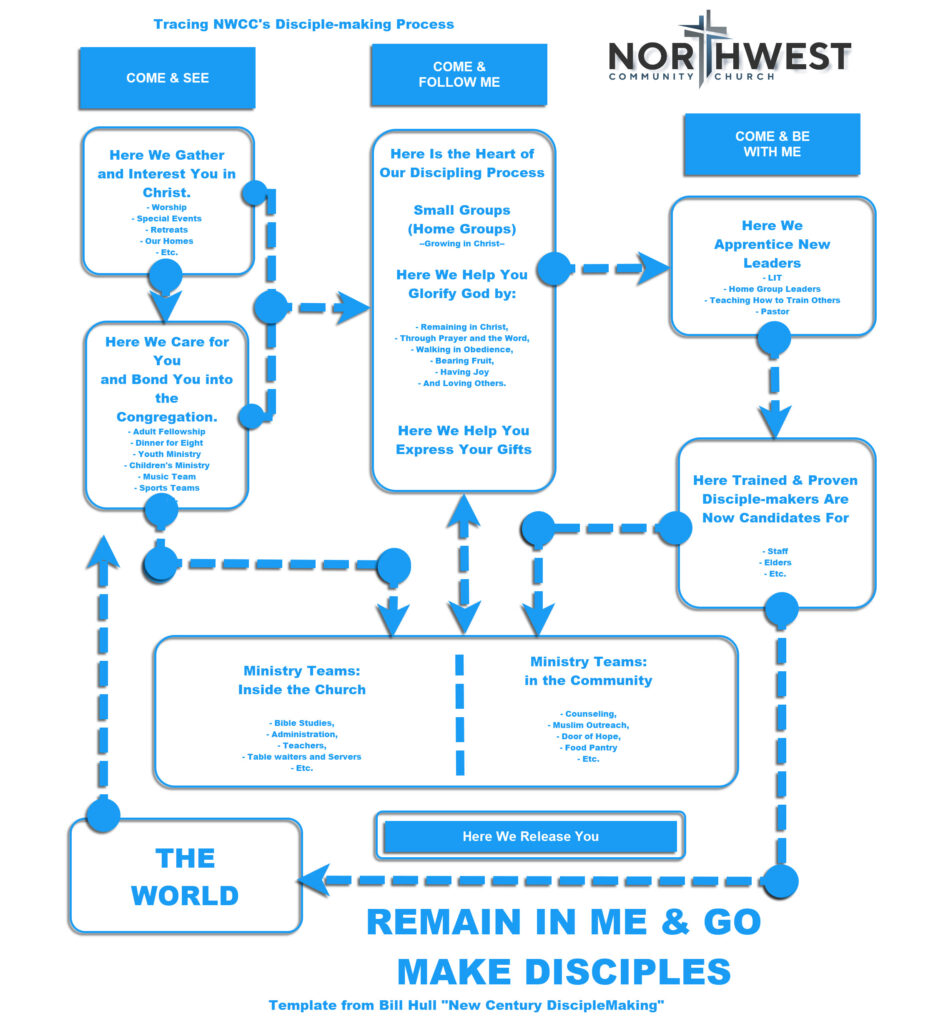
As the Discipleship Pastor, my purpose centers on leading the church’s efforts to fulfill the Great Commission (Matthew 28:19–20) while fostering spiritual growth, maturity, and multiplication among believers. This role often bridges pastoral care, counseling, teaching, equipping, and strategic oversight to create a disciple-making culture.
Core Purpose as Discipleship Pastor
The overarching purpose is to equip and lead the church to make, mature, and multiply disciples of Jesus Christ who glorify God, obey His commands, live in community, and reproduce the process in others—transforming individuals, families, and the broader community for Kingdom impact.
This draws directly from Scripture:
- Proclaiming Christ and baptizing (evangelism/entry).
- Teaching obedience to all Jesus commanded (growth/maturity).
- Equipping saints for ministry (Ephesians 4:11–13) so the body builds itself up.
- Generational multiplication (2 Timothy 2:2).
In practice, this means keeping the church from mere attendance or programs to intentional, relational disciple-making that permeates every ministry (home groups, bible studies, one-to-one or group discipleship meetings, counseling, families, fellowship, youth, college and career, music, sports teams, outreach, etc.).
Jesus’ relational, intentional, formational approach—spending time with disciples, modeling life, teaching obedience, and sending them out) while adapting to modern contexts. No single model is “perfect,” but effective ones combine elements like relationships, teaching, accountability, and mission.
- Jesus-Style / Life-on-Life Discipleship (Relational & Imitational – Often Seen as the Biblical Ideal)
- Description: Discipleship happens through intentional, everyday relationships where a more mature believer invests deeply in another’s life—sharing meals, modeling obedience, coaching through challenges, and encouraging multiplication. Jesus spent most of His time with His disciples “as we go” (teaching, serving, sending), not in formal settings.
- Strengths: Deep transformation, reproducible (disciples make disciples), builds authentic community and accountability.
- Challenges: Time-intensive; requires mature leaders; harder to scale without structure.
- Best for: Core leadership development, small triads/quads (3–4 people), or personal mentoring. Many advocate this as the foundation (e.g., “be with Jesus, become like Jesus, do what He did”).
- Implementation tip: Start with a few committed people; use tools like shared life rhythms (prayer, Scripture, mission).
- One-on-One Mentoring Model
- Description: A mature believer pairs with one less mature believer for personalized guidance—meeting regularly for Bible study, prayer, accountability, and life application.
- Strengths: Highly personalized; addresses individual needs; strong for new believers or leaders.
- Challenges: Not easily scalable (one person can only mentor a few); risk of dependency if not multiplication-focused.
- Best for: New converts, leadership pipeline, or high-touch situations. Often combined with other models.
- Small Group Discipleship Model
- Description: Groups of 6–12 meet regularly (weekly/bi-weekly) for Bible study, prayer, sharing, accountability, and mutual encouragement. Can be male-specific or female-specific, life-stage based, or missional.
- Strengths: Balances intimacy and scale; fosters community and peer support; easier to multiply by splitting groups.
Challenges: Can become inward-focused or discussion-only if not mission-oriented. - Best for: Most churches’ primary engine—integrates well with Sunday services or home groups.
- Classroom / Seminar-Based or Educational Model
- Description: Structured teaching through classes, courses, seminars, or curriculum (e.g., on doctrine, spiritual disciplines, books of the Bible). Often larger settings with lectures, homework, and discussion.
- Strengths: Efficient for broad knowledge transfer; good for foundational teaching; scalable.
- Challenges: Can stay informational (head knowledge) rather than transformational (heart obedience); less relational depth.
- Best for: New believer classes, equipping tracks, or doctrinal depth. Pair with relational elements to avoid “knowledge-only” pitfalls.
- Family-Centered Discipleship Model
- Description: The church equips parents/households as primary disciple-makers—providing resources, training, and support so families disciple at home (Deuteronomy 6 emphasis).
- Strengths: Aligns with biblical priority of family; long-term impact on generations; integrates faith into daily life.
- Challenges: Depends on parent maturity/engagement; risks uneven quality if parents are passive.
- Best for: Children’s/youth ministries or family-focused churches; great for community outreach.